
Asset Management System
Know where every asset is—and who is responsible.
Flatorb connects asset identity, location, custody, condition, maintenance, audits and lifecycle value in one dependable operational record.
Asset management explained
What is an asset management system?
Asset management software keeps a controlled record of each physical asset across acquisition, identification, assignment, movement, condition, maintenance, audits, financial value and retirement.
Flatorb adds the engineered workflows and identification points that keep the register aligned with what is actually happening.
An asset management system tells you what the asset is, where it is, who is responsible, what condition it is in and what must happen next.
A financial register can show what the business owns. Dependable asset control also records handovers, availability, location, inspection, service, evidence and exceptions while the asset is being used.
Follow the asset lifecycleWhat does the business own?
Records capitalization, depreciation, book value and accounting status.
What is happening to each asset?
Controls identity, custody, movement, availability, condition, maintenance and audits.
Which enterprise process is connected?
Manages purchases, employees, suppliers, costs and resulting transactions.
Complete asset lifecycle
Connect acquisition, custody, maintenance, audit and retirement.
One continuous record follows the asset through operations, maintenance, finance and audit. Each event has an owner, validation and exception path.
Start with the lifecycle stages creating the clearest loss, downtime, searching or reconciliation effort.
- 01Acquire
Create the asset record before control begins.
Capture supplier, purchase, ownership, warranty, capitalization and supporting documents at acquisition or data migration.
Supplier · value · warranty - 02Identify
Give every asset a dependable digital identity.
Classify the asset, connect components and accessories, attach photographs and apply the right QR, barcode, RFID or NFC tag.
Register · classify · tag - 03Deploy
Assign assets to the people and places using them.
Control reservations, issues, handovers and acknowledgements across employees, departments, projects, shifts and sites.
Reserve · issue · acknowledge - 04Control
Keep movement, custody, condition and availability visible.
Validate transfers, returns, temporary custody, discrepancies and condition changes without losing the asset history.
Move · return · inspect - 05Maintain
Plan service and preserve the complete reliability record.
Schedule preventive work, manage internal or external repairs and connect cost, downtime, parts and evidence to the asset.
Plan · repair · verify - 06Audit & retire
Reconcile the register and close the lifecycle correctly.
Verify physical assets, investigate variances and control revaluation, impairment, sale, return, scrap or retirement.
Audit · account · dispose
Asset management capabilities
Build one dependable operational and financial asset history.
Configure required information, approvals and controls by asset type, value, location, company, operating risk and user role.
Complete asset registry
Manage unique identity, hierarchy, category, specification, documents, photographs, supplier, warranty and ownership.
Location and custody history
See every assignment, handover, transfer, return and responsible person across organizations and sites.
Reservations and availability
Protect shared equipment from conflicting bookings and show why an asset is unavailable and when it will return.
Condition and inspections
Use checklists, evidence and exception workflows to keep condition, calibration and compliance current.
Maintenance and repairs
Plan preventive work, issue work orders, manage vendors and retain cost, parts, downtime and repair history.
Physical asset audits
Run full, sample, blind or surprise counts using phone scanning or handheld RFID and resolve every variance.
Financial lifecycle
Connect acquisition, capitalization, depreciation, book value, revaluation, impairment, transfer and disposal.
Approvals, alerts and audit trail
Apply role, value, location and asset-group controls with time-stamped actions and exception escalation.
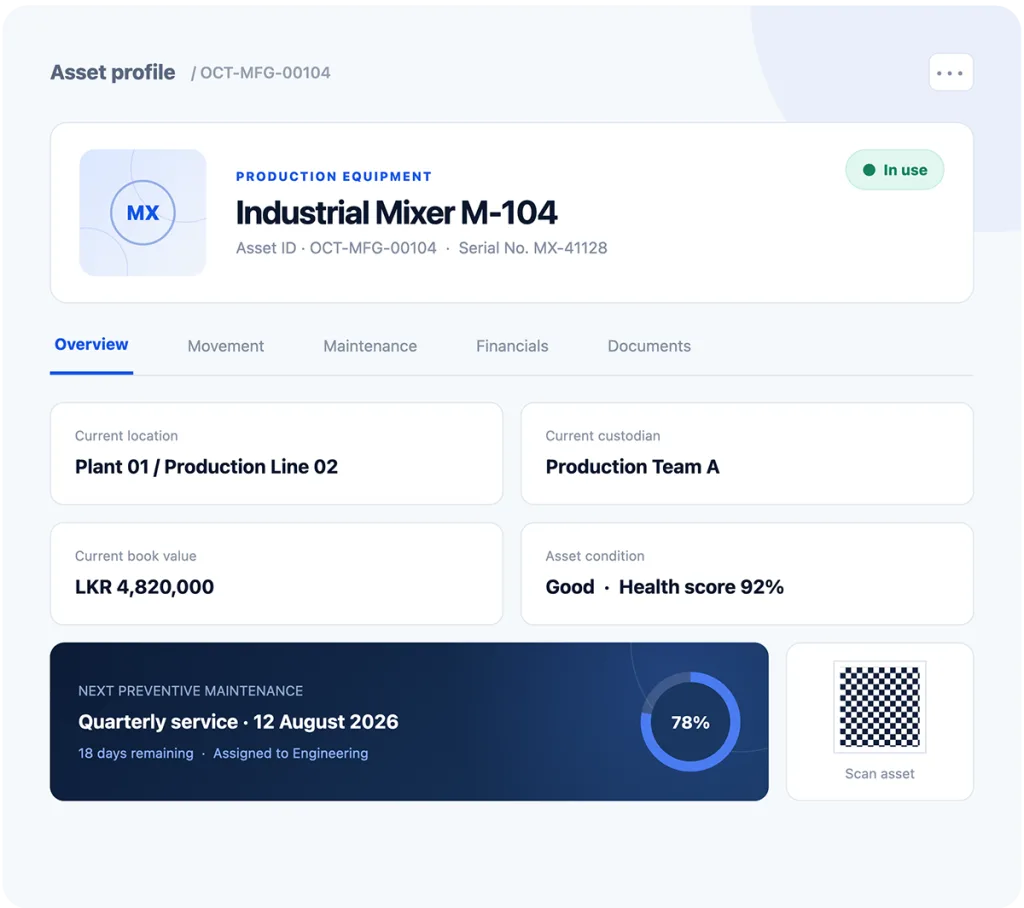 One digital identity for every asset
Asset registry & identification
Scan one asset—or verify hundreds at once.
Flatorb matches the identification method to the asset, environment, transaction speed and business case. Different asset groups can use different technologies inside one controlled system.
QR & barcode
Economical identification with phone cameras or dedicated scanners.
RFID
Faster verification, bulk audits and controlled read points where justified.
NFC
Close-range tap interactions for selected equipment and service workflows.
GPS & connected signals
Location and operating context for suitable vehicles and mobile assets.
Maintenance, finance & integration
Keep physical control connected to maintenance and financial reality.
OCTO Ops can operate as the asset control layer while exchanging employee, supplier, purchase, maintenance and financial information with ERP, finance, HR, procurement and business-intelligence systems.
- Preventive maintenance by date, usage, meter or condition
- Work orders, repairs, vendors, parts, costs and downtime
- Capitalization, depreciation, revaluation and disposal
- API, webhook, file or suitable scheduled data exchange
Asset-intensive operations
Configure the system around the assets, risks and work environment.
Asset control is different for production equipment, healthcare devices, hotel operations and shared field tools. Flatorb adapts categories, custody, approvals, inspections and reports to the real operating model.
Protect machinery, tools, moulds, safety and production equipment.
Connect location, condition, calibration, maintenance and responsibility across plants, lines and workshops.
Control engineering, kitchen, housekeeping, IT and movable assets.
Track equipment across rooms, departments, stores, repair centres and multiple properties.
Keep equipment location, calibration and inspection evidence current.
Apply department custody, restricted access, maintenance controls and auditable history.
See availability, reservations, issues, returns and mobile asset location.
Reduce double bookings, missing accessories, overdue returns and assets stranded between branches or projects.
From register to operational control
Answer the questions that determine accountability, availability and lifecycle cost.
The result is more than a list of assets. It is a dependable history that helps teams act while the asset is moving, being used, serviced or audited.
| Operational question | What the system controls | Business outcome |
|---|---|---|
| Where is the asset? | Location and movementSite, area, project, transfer, dispatch and receipt | Less searchingFind equipment faster and identify overdue movements |
| Who is responsible? | Custody and acknowledgementEmployee, department, shift, condition and return date | Clear accountabilityResolve handovers, exits and missing items with evidence |
| Is it safe and available? | Condition and maintenanceInspection, calibration, service, repair and downtime | Better reliabilityProtect availability and intervene before commitments fail |
| Does the register match? | Physical audit workflowExpected list, scan, variance, evidence and approval | Audit confidenceClose discrepancies without uncontrolled record changes |
| What is the lifecycle cost? | Financial historyAcquisition, depreciation, maintenance, impairment and disposal | Better decisionsCompare repair, replacement, utilization and residual value |
Asset system implementation
Move from a static register to reliable daily asset control.
A dependable implementation connects clean opening data, practical identification, controlled workflows, working interfaces and adopted daily responsibility.
- 01DiscoverMap asset types, movements, responsibilities, controls and reporting needs.
- 02PrepareClean the register and define categories, locations, roles and ownership.
- 03ConfigureBuild workflows, approvals, alerts, reports, tags and integrations.
- 04Tag & proveLabel a controlled scope and test real issues, transfers, audits and exceptions.
- 05ImplementMigrate, train, reconcile and move into dependable daily operation.
- 06ImproveMeasure adoption, loss, downtime and audit effort, then expand proven controls.
Asset management questions
Practical answers before you invest.
The right scope depends on asset types, data quality, locations, users, custody patterns, maintenance needs, identification technology and connected systems.
Ask about your assets01What is an asset management system?+
An asset management system keeps a controlled record of physical assets across acquisition, identification, assignment, movement, condition, maintenance, audits, financial value and retirement. It helps operations, maintenance, finance and audit teams work from the same dependable lifecycle history.
02What types of assets can Flatorb manage?+
A solution can manage fixed assets, machinery, tools, equipment, IT devices, furniture, vehicles, safety equipment, rental equipment, controlled keys, components, kits and other physical assets. Required fields and controls can vary by category.
03Can we import an existing spreadsheet or asset register?+
Yes. Existing identifiers, categories, values, locations, custodians and other records can be reviewed, cleaned and imported. The implementation should include duplicate detection, data validation and a physical reconciliation before the new register becomes authoritative.
04What is the difference between QR, barcode, NFC, RFID and GPS asset tracking?+
QR and barcode provide economical one-at-a-time scanning. NFC supports close-range tap interactions. RFID can verify multiple tagged assets more quickly, while GPS provides location signals for suitable mobile assets. Flatorb selects the method for the asset, environment, control point and business case.
05Can the system manage employee asset assignments and exit clearance?+
Yes. Issues can include approvals, condition, accessories, documents, return dates and acknowledgement. The complete custody history remains available, and employee transfer or exit workflows can identify assets that must be returned or reassigned.
06Does it include preventive maintenance and repair management?+
Yes. Maintenance can be scheduled by date, usage, runtime, mileage, meter reading or condition. Teams can issue work orders, assign technicians or vendors, record parts and labor, measure downtime and preserve the complete service history.
07Can asset management integrate with ERP, finance, HR and procurement?+
Yes. OCTO Ops can operate independently or exchange employee, supplier, purchase, financial, maintenance and asset information with existing systems through suitable APIs, webhooks, files or scheduled data exchange.
08Can Flatorb implement asset management internationally?+
Yes. Discovery, data preparation, configuration, training and support can often be delivered through structured remote collaboration. Where physical assessment, tagging, RFID engineering or commissioning is required, Flatorb can arrange site work.
Begin with the control gap
Which assets are hardest to locate, assign, maintain or audit?
Show us the asset movement or lifecycle event creating the most risk. We’ll help define a practical operating model, technology choice and implementation path.
- Clarify the asset event and responsibility that must be controlled
- Review locations, users, existing data and connected systems
- Identify a measurable first asset group or implementation scope